An award-winning cannabis podcast for women, by women. Hear joyful stories and useful advice about cannabis for health, well-being, and fun—especially for needs specific to women like stress, sleep, and sex. We cover everything from: What’s the best weed for sex? Can I use CBD for menstrual cramps? What are the effects of the Harlequin strain or Gelato strain? And, why do we prefer to call it “cannabis” instead of “marijuana”? We also hear from you: your first time buying legal weed, and how ...
…
continue reading

תוכן מסופק על ידי Magnetic Memory Method – How to Memorize With A Memory Palace. כל תוכן הפודקאסטים כולל פרקים, גרפיקה ותיאורי פודקאסטים מועלים ומסופקים ישירות על ידי Magnetic Memory Method – How to Memorize With A Memory Palace או שותף פלטפורמת הפודקאסט שלהם. אם אתה מאמין שמישהו משתמש ביצירה שלך המוגנת בזכויות יוצרים ללא רשותך, אתה יכול לעקוב אחר התהליך המתואר כאן https://he.player.fm/legal.
דומה לMagnetic Memory Method – How to Memorize With A Memory Palace
If you are looking to increase your self love, confidence & self esteem then the The Confidence AND Self Esteem Podcast .com is for you. A mixture of stories, motivational talks and practical advice hosted by James Blundell. Become a supporter of this podcast: https://www.spreaker.com/podcast/confidence-self-esteem-podcast--3128218/support.
…
continue reading
Everyone has a dream. But sometimes there’s a gap between where we are and where we want to be. True, there are some people who can bridge that gap easily, on their own, but all of us need a little help at some point. A little boost. An accountability partner. A Snooze Squad. In each episode, the Snooze Squad will strategize an action plan for people to face their fears. Guests will transform their own perception of their potential and walk away a few inches closer to who they want to become ...
…
continue reading
Are you looking for more happiness, success and vitality in your life? Get inspired each week with wellness and performance expert, Integrative Medicine Fellow, author & keynote speaker, Kristel Bauer. Live Greatly shares empowering conversations and insights about happiness, wellness & success to support your personal and professional development. Kristel talks with top experts, leaders and inspiring individuals to help you embrace a growth mindset and excel in your work/life. Kristel then ...
…
continue reading
Named by Oprah as a thought leader for the next generation and one of Inc.'s 500 fastest growing companies, Marie Forleo's goal is to help you become the person you most want to be. In this show, Marie and her guests share actionable strategies for greater happiness, success, motivation, creativity, productivity, love, health, contribution and fulfillment — often with a lot of laughs. From business, marketing and career advice, to tackling failure, disappointment and fear, to philanthropy an ...
…
continue reading
The Washington Post's Presidential podcast explores how each former American president reached office, made decisions, handled crises and redefined the role of commander-in-chief. It was released leading up to up to Election Day 2016, starting with George Washington in week one and ending on week 44 with the president-elect. New special episodes in the countdown to the 2020 presidential election highlight other stories from U.S. presidential history that can help illuminate our current momen ...
…
continue reading
Best friends Joel and Matt are the co-hosts of How to Money which is all about providing the knowledge & tools that normal folks need to thrive in areas like debt payoff, DIY investing, and crucial money tricks that will provide continuous help along your journey. We believe that access to unbiased and jargon-free personal finance guidance is more necessary than ever before. When you handle your money in a purposeful, thoughtful way that works for your lifestyle, you can really start living ...
…
continue reading

1
Every Day Is Saturday Podcast For Motivation, Inspiration And Success
Self Improvement Coach Sam Crowley
 1k
1k 900
900


One of the top motivational podcasts for 18 years and running. Motivational messages to keep you inspired throughout the week. Success comes in all shapes and sizes. Sam Crowley’s authentic message will provide the inspiration you need to conquer the challenges and claim your power.
…
continue reading
Self Improvement Daily is the most consistent and value-packed podcast in the space. Every episode is specifically created to help busy, purpose-driven leaders acquire the ideas, structure, clarity, and perspective they need to maximize their potential and impact. Featuring a new 3-5 minute tip every weekday, biweekly expert interviews, never missing a day for the last 7.5 years, and having earned 21.4 million downloads to date - This is your path toward becoming the successful, impactful, a ...
…
continue reading
BackStory is a weekly public podcast hosted by U.S. historians Ed Ayers, Brian Balogh, Nathan Connolly and Joanne Freeman. We're based in Charlottesville, Va. at Virginia Humanities. There’s the history you had to learn, and the history you want to learn - that’s where BackStory comes in. Each week BackStory takes a topic that people are talking about and explores it through the lens of American history. Through stories, interviews, and conversations with our listeners, BackStory makes histo ...
…
continue reading

Player FM - אפליקציית פודקאסט
התחל במצב לא מקוון עם האפליקציה Player FM !
התחל במצב לא מקוון עם האפליקציה Player FM !

))

The Polymathic Poet Who Taught Himself “Impossible” Skills


Manage episode 523782603 series 3235856
תוכן מסופק על ידי Magnetic Memory Method – How to Memorize With A Memory Palace. כל תוכן הפודקאסטים כולל פרקים, גרפיקה ותיאורי פודקאסטים מועלים ומסופקים ישירות על ידי Magnetic Memory Method – How to Memorize With A Memory Palace או שותף פלטפורמת הפודקאסט שלהם. אם אתה מאמין שמישהו משתמש ביצירה שלך המוגנת בזכויות יוצרים ללא רשותך, אתה יכול לעקוב אחר התהליך המתואר כאן https://he.player.fm/legal.
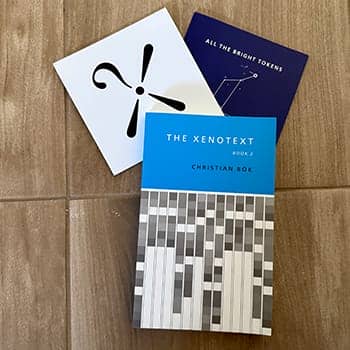 If you want to understand the future of learning and equip yourself with the best possible tools for operating at the top of your game, I believe becoming polymathic is your best bet.
And to succeed in mastering multiple skills and tying together multiple domains of knowledge, it’s helpful to have contemporary examples.
Especially from people operating way out on the margins of the possible.
That’s why today we’re looking at what happens when a poet decides to stop writing on easily destroyed paper.
Ebooks and the computers that store information have a shelf life too.
No, we’re talking about what happens when a poet starts “writing” into the potentially infinite cellular matter of a seemingly unkillable bacterium.
This is the story of The Xenotext.
How it came to be, how it relates to memory and the lessons you can learn from the years Christian Bök spent teaching himself the skills needed to potentially save humanity’s most important art from the death of our sun.
Poetry.
But more importantly, this post is a blueprint for you. The story of The Xenotext is a masterclass in why the era of the specialist is over, and why the future belongs to the polymaths who dare to learn the “impossible” by bringing together multiple fields.
What on earth could be impossible, you ask?
And what does any of this have to do with memory?
Simple:
Writing in a way that is highly likely to survive the death of the sun changes the definition of what memory is right now. And it should change what we predict memory will be like in both the near and distant future.
Encoding Literature Into Life: The Xenotext
Christian Bök, often described as a conceptual poet, has run experiments with words for decades.
For example, Eunoia is a univocal lipogram.
That means, in each chapter, Bök used only words containing one of the vowels.
This is a constraint, and it leads to lines like, “Awkward grammar appals a craftsman.” And “Writing is inhibiting.”
There are other “programs” or constraints Bök used to construct the poem. As a result, you hear and feel the textures of your own mother tongue in a completely new way as you read the poem.
But for The Xenotext project, Bök wondered if it would be possible to discover the rules and constraints that would enable himself, and conceivably other poets and writers, to encode poetry into a living organism.
That leads to a fascinating question about memory that many mnemonists have tackled, even if they’re not fully aware of it.
Can a poem outlive the civilization that produced it?
If so, and humans are no longer around, how would that work?
The Science of How Biology Becomes Poetry
As far as I can understand, one of the first steps involved imagining the project itself, followed by learning how it could be possible for a poem to live inside of a cell.
And which kind of cell would do the job of protecting the poetry?
It turns out that there’s an “extremophile” called Deinococcus radiodurans. It was listed in the Guinness Book of World Records as the most radiation resistant bacterium on planet Earth.
As a life form, its DNA was sequenced and published in 1999. According to the Wikipedia page on The Xenotext, Bök started conceiving of encoding poetry into DNA and then inserting it into the bacterium circa 2002.
But the project is about more than having poetry persist within a cell so it can transmit the work without errors later. It’s a kind of combinatory puzzle in which the bacterium acts as a kind of co-author.
In order to pull this project off, Bök needed to enlist the help of scientists while mastering multiple skills many people would not normally consider “writing.”
But as we head into the future, we definitely should.
Radical Autodidacticism:
Reaching New Heights Through Deep Discipline
To this day, many educators talk about the importance of being a specialist. But The Xenotext project and the work Bök put into it forces us to redefine what it means to be a self-directed learner in the 21st century.
When Bök decided to encode a poem into the DNA of an extremophile bacterium, he didn’t just “dabble” in science or explore various interests as a multipotentialite. Nor did he read a few pop-sci books and expect an organism to write a poem in return.
No, he spent many years studying genomic and proteomic engineering. He coded his own computer program to help him “unearth” the poetry, all while writing grants and collaborating with multiple experts.
The Skill Stack
If you’re a lifelong learner with big dreams, it’s useful to examine how people with autodidactic and polymathic personality traits operate.
One of the first skills is to allow yourself to dream big. Giving oneself permission like this might not seem like a skill. But since we can model any polymath or other person who inspires us, you probably won’t be surprised that many of the most inspiring polymaths regularly daydream.
Picking a dream and pursuing it despite any obstacles is also a skill.
And once you’ve got a project, the next step is to take a cue from a polymath like Elon Musk and break your goal down into the most basic principles. No matter how unusual or unlikely your dream, it’s a useful exercise.
When it comes to analytical thinking and breaking a goal down so you can start pursuing it, it’s often useful to look at your existing competence.
In Bök’s case, I believe he wrote Eunoia by culling words manually from dictionaries over many years. But he couldn’t brute force The Xenotext in that way due to all the biological chemistry involved, so he had to become what you might think of as a computational linguist.
My point is not to diminish the originality of this project in any way. But I think it’s helpful to recognize that The Xenotext is not wildly divorced from the skills Bök already had. It’s an evolution that draws from them.
There’s also the skill of what Waqas Ahmed calls synesthetic thinking in his book, The Polymath. Not to be mistaken with synesthesia, synesthetic thinking involves imagining an outcome through at least one other sense.
In Bök’s case, The Xenotext involves imagining the use of living beings other than human as being part of art. And he has described the possibility that his work could reach “a sufficiently intelligent civilization that has fast computers and smart cryptographers.” This is the skill of sensing beyond our own species and taking the risk of trying to reach them.
Even if we’re long gone.
We Need Deathless Memory
Now, I have a confession to make.
One of the many reasons I’m so fascinated by The Xenotext is that my memory is incredibly weak. That’s why I use mnemonics with such passion, including for memorizing poetry.
Recently, I had the chance to interview Christian Bök, who you can probably tell by now, I consider to be one of the most rigorous intellects alive.
And right in the middle of the interview, I started reciting one of his books from Book I of The Xenotext. For all the mnemonics in the world, I choked.
Now, sometimes, this happens just because I have mouth problems and things get a bit sticky. Other times, it’s exhaustion and yet other times, I manage to recite poems with no problem at all.
I’m mentioning this human moment in my career as a mnemonist not because I have a deep need to confess.
No, this fragile, ephemeral human moment while talking about encoding and retrieving information perfectly from its placement within a living cell suggests the possibility that life really can be the most durable storage device in the universe.
And to see this project come to fruition after all the years Bök pushed through multiple struggles inspires me in countless ways.
For one thing, Bök’s project strikes me as the ultimate memory strategy.
Was Poetry the Original Hard Drive?
As Bök reminded me during our discussion, poetry was a memory technology long before writing existed. Rhythm, rhyme, and meter were engineering tools used to ensure information survived the “game of telephone” across generations.
In Bök’s words:
“We certainly owe every great epic story of the sort like the Epic of Gilgamesh or the Iliad… stories that were intended, of course, to transmit important cultural information over long periods of time. We need poets to be able to create that work and make it memorable enough… to persist over time.”
And it is in this context that Christian Bök realized something terrifying:
“There’s nothing that we’ve built so far on the planet Earth that would probably last more than a few tens of billions of years at most.”
Until his work on The Xenotext succeeded, we have had nothing to rely on apart from our brains assisted by techniques like the Memory Palace, or silicon prostheses.
But the computers and servers we now use to store our collective memory are just as subject to rot as paper. Even our homes would be ground into “an almost undetectable layer of geological dust” in just a few million years.
So Bök’s selection of a deathless bacterium isn’t just a petri dish stunt. By choosing a specific bacterium that is “widely regarded as one of the most unkillable things ever to have evolved on the planet Earth,” Bök has created a memory inside a “message in a bottle thrown into an enormous ocean” that might actually survive the death of our sun.
How to Develop Your Own Polymathic Persistence
Reading this, you might be thinking, “I’m just a student,” or “I’m just a writer.”
Bök could have thought that too.
As he told me: “My assumption was that I’ve got training in English literature… Obviously, in order to embark upon such a project, I had to acquire a whole set of new skills, familiarize myself with a lot of very difficult discourses.”
And so he made the decision to step outside of his lane, joining other innovators who have done the same.
But how do you engage in a project that takes decades without burning out? Bök gave me three specific clues you can apply to your own learning journey.
One: Embrace the Unknown
Bök told me that if he had known how hard the project would be, he might not have started.
He called this his “saving grace,” yet how many times do we turn away from our dreams because we don’t know the size of the mountain.
Nelson Dellis told me something similar once about memory training. He’s a memory champion, but also a climber who has summited Everest.
He said you don’t have to worry about whether the top of the mountain is there or not. Just focus on where you’re going to place your hands next.
Two: Focus on Incremental Achievement
Even as Bök’s project threw new obstacles at him, he told me:
“I gave myself accomplishments or achievements that were incremental, that I knew I could probably fulfill, and would embark upon those doable tasks in an effort to acquire the required skill set in order to accomplish the remainder of these tasks.”
In other words, he stacked small, doable wins on top of each other. And kept stacking until he had built a ladder to the impossible.
Three: Tunnel Through the Noise
Bök was candid about some of the loneliness on the path of the polymath.
Sadly, he noted:
This project, especially, has been beleaguered with all kinds of obstruction and difficulty that were added to the already difficult task at hand and the improbable kinds of risks that I had to adopt in order to be able to accomplish it.
His advice having pushed through and made it to the other side?
“If you’re going through hell, keep going. Don’t stop, because otherwise, you’re in hell… Just keep going, try to tunnel through.”
Bök’s work definitely makes a big statement when it comes to 21st century poetry.
But for me, it’s also a statement about memory and human potential.
The Xenotext challenges us to stop thinking of computers as something that has eclipsed the human brain as the ultimate storage and retrieval device. It places our attention squarely back on the relationship between poetry and life, and the aspects of language that were in so many ways already a technology “infecting” our cells.
If you want to become a polymath and enjoy a legacy that lasts, you must be willing to endure what Bök described as “36 different side quests” of complex projects, you must be willing to look at subjects and skills that seem “impossible” and learn them anyway.
Ready to start your own “impossible” learning project? I have a guide that will help you develop your own curriculum:

This Self-Education Blueprint will help you transform scattered curiosity into tightly interwoven levels of expertise.
That way, the knowledge you accumulate gets put to use, and above all, helps others too.
The post The Polymathic Poet Who Taught Himself “Impossible” Skills appeared first on Magnetic Memory Method - How to Memorize With A Memory Palace.
18 פרקים
The Polymathic Poet Who Taught Himself “Impossible” Skills
Magnetic Memory Method – How to Memorize With A Memory Palace
 שתפו
שתפו


Manage episode 523782603 series 3235856
תוכן מסופק על ידי Magnetic Memory Method – How to Memorize With A Memory Palace. כל תוכן הפודקאסטים כולל פרקים, גרפיקה ותיאורי פודקאסטים מועלים ומסופקים ישירות על ידי Magnetic Memory Method – How to Memorize With A Memory Palace או שותף פלטפורמת הפודקאסט שלהם. אם אתה מאמין שמישהו משתמש ביצירה שלך המוגנת בזכויות יוצרים ללא רשותך, אתה יכול לעקוב אחר התהליך המתואר כאן https://he.player.fm/legal.
If you want to understand the future of learning and equip yourself with the best possible tools for operating at the top of your game, I believe becoming polymathic is your best bet.
And to succeed in mastering multiple skills and tying together multiple domains of knowledge, it’s helpful to have contemporary examples.
Especially from people operating way out on the margins of the possible.
That’s why today we’re looking at what happens when a poet decides to stop writing on easily destroyed paper.
Ebooks and the computers that store information have a shelf life too.
No, we’re talking about what happens when a poet starts “writing” into the potentially infinite cellular matter of a seemingly unkillable bacterium.
This is the story of The Xenotext.
How it came to be, how it relates to memory and the lessons you can learn from the years Christian Bök spent teaching himself the skills needed to potentially save humanity’s most important art from the death of our sun.
Poetry.
But more importantly, this post is a blueprint for you. The story of The Xenotext is a masterclass in why the era of the specialist is over, and why the future belongs to the polymaths who dare to learn the “impossible” by bringing together multiple fields.
What on earth could be impossible, you ask?
And what does any of this have to do with memory?
Simple:
Writing in a way that is highly likely to survive the death of the sun changes the definition of what memory is right now. And it should change what we predict memory will be like in both the near and distant future.
Encoding Literature Into Life: The Xenotext
Christian Bök, often described as a conceptual poet, has run experiments with words for decades.
For example, Eunoia is a univocal lipogram.
That means, in each chapter, Bök used only words containing one of the vowels.
This is a constraint, and it leads to lines like, “Awkward grammar appals a craftsman.” And “Writing is inhibiting.”
There are other “programs” or constraints Bök used to construct the poem. As a result, you hear and feel the textures of your own mother tongue in a completely new way as you read the poem.
But for The Xenotext project, Bök wondered if it would be possible to discover the rules and constraints that would enable himself, and conceivably other poets and writers, to encode poetry into a living organism.
That leads to a fascinating question about memory that many mnemonists have tackled, even if they’re not fully aware of it.
Can a poem outlive the civilization that produced it?
If so, and humans are no longer around, how would that work?
The Science of How Biology Becomes Poetry
As far as I can understand, one of the first steps involved imagining the project itself, followed by learning how it could be possible for a poem to live inside of a cell.
And which kind of cell would do the job of protecting the poetry?
It turns out that there’s an “extremophile” called Deinococcus radiodurans. It was listed in the Guinness Book of World Records as the most radiation resistant bacterium on planet Earth.
As a life form, its DNA was sequenced and published in 1999. According to the Wikipedia page on The Xenotext, Bök started conceiving of encoding poetry into DNA and then inserting it into the bacterium circa 2002.
But the project is about more than having poetry persist within a cell so it can transmit the work without errors later. It’s a kind of combinatory puzzle in which the bacterium acts as a kind of co-author.
In order to pull this project off, Bök needed to enlist the help of scientists while mastering multiple skills many people would not normally consider “writing.”
But as we head into the future, we definitely should.
Radical Autodidacticism:
Reaching New Heights Through Deep Discipline
To this day, many educators talk about the importance of being a specialist. But The Xenotext project and the work Bök put into it forces us to redefine what it means to be a self-directed learner in the 21st century.
When Bök decided to encode a poem into the DNA of an extremophile bacterium, he didn’t just “dabble” in science or explore various interests as a multipotentialite. Nor did he read a few pop-sci books and expect an organism to write a poem in return.
No, he spent many years studying genomic and proteomic engineering. He coded his own computer program to help him “unearth” the poetry, all while writing grants and collaborating with multiple experts.
The Skill Stack
If you’re a lifelong learner with big dreams, it’s useful to examine how people with autodidactic and polymathic personality traits operate.
One of the first skills is to allow yourself to dream big. Giving oneself permission like this might not seem like a skill. But since we can model any polymath or other person who inspires us, you probably won’t be surprised that many of the most inspiring polymaths regularly daydream.
Picking a dream and pursuing it despite any obstacles is also a skill.
And once you’ve got a project, the next step is to take a cue from a polymath like Elon Musk and break your goal down into the most basic principles. No matter how unusual or unlikely your dream, it’s a useful exercise.
When it comes to analytical thinking and breaking a goal down so you can start pursuing it, it’s often useful to look at your existing competence.
In Bök’s case, I believe he wrote Eunoia by culling words manually from dictionaries over many years. But he couldn’t brute force The Xenotext in that way due to all the biological chemistry involved, so he had to become what you might think of as a computational linguist.
My point is not to diminish the originality of this project in any way. But I think it’s helpful to recognize that The Xenotext is not wildly divorced from the skills Bök already had. It’s an evolution that draws from them.
There’s also the skill of what Waqas Ahmed calls synesthetic thinking in his book, The Polymath. Not to be mistaken with synesthesia, synesthetic thinking involves imagining an outcome through at least one other sense.
In Bök’s case, The Xenotext involves imagining the use of living beings other than human as being part of art. And he has described the possibility that his work could reach “a sufficiently intelligent civilization that has fast computers and smart cryptographers.” This is the skill of sensing beyond our own species and taking the risk of trying to reach them.
Even if we’re long gone.
We Need Deathless Memory
Now, I have a confession to make.
One of the many reasons I’m so fascinated by The Xenotext is that my memory is incredibly weak. That’s why I use mnemonics with such passion, including for memorizing poetry.
Recently, I had the chance to interview Christian Bök, who you can probably tell by now, I consider to be one of the most rigorous intellects alive.
And right in the middle of the interview, I started reciting one of his books from Book I of The Xenotext. For all the mnemonics in the world, I choked.
Now, sometimes, this happens just because I have mouth problems and things get a bit sticky. Other times, it’s exhaustion and yet other times, I manage to recite poems with no problem at all.
I’m mentioning this human moment in my career as a mnemonist not because I have a deep need to confess.
No, this fragile, ephemeral human moment while talking about encoding and retrieving information perfectly from its placement within a living cell suggests the possibility that life really can be the most durable storage device in the universe.
And to see this project come to fruition after all the years Bök pushed through multiple struggles inspires me in countless ways.
For one thing, Bök’s project strikes me as the ultimate memory strategy.
Was Poetry the Original Hard Drive?
As Bök reminded me during our discussion, poetry was a memory technology long before writing existed. Rhythm, rhyme, and meter were engineering tools used to ensure information survived the “game of telephone” across generations.
In Bök’s words:
“We certainly owe every great epic story of the sort like the Epic of Gilgamesh or the Iliad… stories that were intended, of course, to transmit important cultural information over long periods of time. We need poets to be able to create that work and make it memorable enough… to persist over time.”
And it is in this context that Christian Bök realized something terrifying:
“There’s nothing that we’ve built so far on the planet Earth that would probably last more than a few tens of billions of years at most.”
Until his work on The Xenotext succeeded, we have had nothing to rely on apart from our brains assisted by techniques like the Memory Palace, or silicon prostheses.
But the computers and servers we now use to store our collective memory are just as subject to rot as paper. Even our homes would be ground into “an almost undetectable layer of geological dust” in just a few million years.
So Bök’s selection of a deathless bacterium isn’t just a petri dish stunt. By choosing a specific bacterium that is “widely regarded as one of the most unkillable things ever to have evolved on the planet Earth,” Bök has created a memory inside a “message in a bottle thrown into an enormous ocean” that might actually survive the death of our sun.
How to Develop Your Own Polymathic Persistence
Reading this, you might be thinking, “I’m just a student,” or “I’m just a writer.”
Bök could have thought that too.
As he told me: “My assumption was that I’ve got training in English literature… Obviously, in order to embark upon such a project, I had to acquire a whole set of new skills, familiarize myself with a lot of very difficult discourses.”
And so he made the decision to step outside of his lane, joining other innovators who have done the same.
But how do you engage in a project that takes decades without burning out? Bök gave me three specific clues you can apply to your own learning journey.
One: Embrace the Unknown
Bök told me that if he had known how hard the project would be, he might not have started.
He called this his “saving grace,” yet how many times do we turn away from our dreams because we don’t know the size of the mountain.
Nelson Dellis told me something similar once about memory training. He’s a memory champion, but also a climber who has summited Everest.
He said you don’t have to worry about whether the top of the mountain is there or not. Just focus on where you’re going to place your hands next.
Two: Focus on Incremental Achievement
Even as Bök’s project threw new obstacles at him, he told me:
“I gave myself accomplishments or achievements that were incremental, that I knew I could probably fulfill, and would embark upon those doable tasks in an effort to acquire the required skill set in order to accomplish the remainder of these tasks.”
In other words, he stacked small, doable wins on top of each other. And kept stacking until he had built a ladder to the impossible.
Three: Tunnel Through the Noise
Bök was candid about some of the loneliness on the path of the polymath.
Sadly, he noted:
This project, especially, has been beleaguered with all kinds of obstruction and difficulty that were added to the already difficult task at hand and the improbable kinds of risks that I had to adopt in order to be able to accomplish it.
His advice having pushed through and made it to the other side?
“If you’re going through hell, keep going. Don’t stop, because otherwise, you’re in hell… Just keep going, try to tunnel through.”
Bök’s work definitely makes a big statement when it comes to 21st century poetry.
But for me, it’s also a statement about memory and human potential.
The Xenotext challenges us to stop thinking of computers as something that has eclipsed the human brain as the ultimate storage and retrieval device. It places our attention squarely back on the relationship between poetry and life, and the aspects of language that were in so many ways already a technology “infecting” our cells.
If you want to become a polymath and enjoy a legacy that lasts, you must be willing to endure what Bök described as “36 different side quests” of complex projects, you must be willing to look at subjects and skills that seem “impossible” and learn them anyway.
Ready to start your own “impossible” learning project? I have a guide that will help you develop your own curriculum:
This Self-Education Blueprint will help you transform scattered curiosity into tightly interwoven levels of expertise.
That way, the knowledge you accumulate gets put to use, and above all, helps others too.
The post The Polymathic Poet Who Taught Himself “Impossible” Skills appeared first on Magnetic Memory Method - How to Memorize With A Memory Palace.
18 פרקים
כל הפרקים
×
ברוכים הבאים אל Player FM!
Player FM סורק את האינטרנט עבור פודקאסטים באיכות גבוהה בשבילכם כדי שתהנו מהם כרגע. זה יישום הפודקאסט הטוב ביותר והוא עובד על אנדרואיד, iPhone ואינטרנט. הירשמו לסנכרון מנויים במכשירים שונים.
דומה לMagnetic Memory Method – How to Memorize With A Memory Palace
An award-winning cannabis podcast for women, by women. Hear joyful stories and useful advice about cannabis for health, well-being, and fun—especially for needs specific to women like stress, sleep, and sex. We cover everything from: What’s the best weed for sex? Can I use CBD for menstrual cramps? What are the effects of the Harlequin strain or Gelato strain? And, why do we prefer to call it “cannabis” instead of “marijuana”? We also hear from you: your first time buying legal weed, and how ...
…
continue reading
If you are looking to increase your self love, confidence & self esteem then the The Confidence AND Self Esteem Podcast .com is for you. A mixture of stories, motivational talks and practical advice hosted by James Blundell. Become a supporter of this podcast: https://www.spreaker.com/podcast/confidence-self-esteem-podcast--3128218/support.
…
continue reading
Everyone has a dream. But sometimes there’s a gap between where we are and where we want to be. True, there are some people who can bridge that gap easily, on their own, but all of us need a little help at some point. A little boost. An accountability partner. A Snooze Squad. In each episode, the Snooze Squad will strategize an action plan for people to face their fears. Guests will transform their own perception of their potential and walk away a few inches closer to who they want to become ...
…
continue reading
Are you looking for more happiness, success and vitality in your life? Get inspired each week with wellness and performance expert, Integrative Medicine Fellow, author & keynote speaker, Kristel Bauer. Live Greatly shares empowering conversations and insights about happiness, wellness & success to support your personal and professional development. Kristel talks with top experts, leaders and inspiring individuals to help you embrace a growth mindset and excel in your work/life. Kristel then ...
…
continue reading
Named by Oprah as a thought leader for the next generation and one of Inc.'s 500 fastest growing companies, Marie Forleo's goal is to help you become the person you most want to be. In this show, Marie and her guests share actionable strategies for greater happiness, success, motivation, creativity, productivity, love, health, contribution and fulfillment — often with a lot of laughs. From business, marketing and career advice, to tackling failure, disappointment and fear, to philanthropy an ...
…
continue reading
The Washington Post's Presidential podcast explores how each former American president reached office, made decisions, handled crises and redefined the role of commander-in-chief. It was released leading up to up to Election Day 2016, starting with George Washington in week one and ending on week 44 with the president-elect. New special episodes in the countdown to the 2020 presidential election highlight other stories from U.S. presidential history that can help illuminate our current momen ...
…
continue reading
Best friends Joel and Matt are the co-hosts of How to Money which is all about providing the knowledge & tools that normal folks need to thrive in areas like debt payoff, DIY investing, and crucial money tricks that will provide continuous help along your journey. We believe that access to unbiased and jargon-free personal finance guidance is more necessary than ever before. When you handle your money in a purposeful, thoughtful way that works for your lifestyle, you can really start living ...
…
continue reading
1
Every Day Is Saturday Podcast For Motivation, Inspiration And Success
Self Improvement Coach Sam Crowley
1k900
One of the top motivational podcasts for 18 years and running. Motivational messages to keep you inspired throughout the week. Success comes in all shapes and sizes. Sam Crowley’s authentic message will provide the inspiration you need to conquer the challenges and claim your power.
…
continue reading
Self Improvement Daily is the most consistent and value-packed podcast in the space. Every episode is specifically created to help busy, purpose-driven leaders acquire the ideas, structure, clarity, and perspective they need to maximize their potential and impact. Featuring a new 3-5 minute tip every weekday, biweekly expert interviews, never missing a day for the last 7.5 years, and having earned 21.4 million downloads to date - This is your path toward becoming the successful, impactful, a ...
…
continue reading
BackStory is a weekly public podcast hosted by U.S. historians Ed Ayers, Brian Balogh, Nathan Connolly and Joanne Freeman. We're based in Charlottesville, Va. at Virginia Humanities. There’s the history you had to learn, and the history you want to learn - that’s where BackStory comes in. Each week BackStory takes a topic that people are talking about and explores it through the lens of American history. Through stories, interviews, and conversations with our listeners, BackStory makes histo ...
…
continue reading
Player FM - אפליקציית פודקאסט
התחל במצב לא מקוון עם האפליקציה Player FM !
התחל במצב לא מקוון עם האפליקציה Player FM !


